What you need to know now about moving to Minnesota:
- Minnesota has 18 Fortune 500 companies headquartered in the Twin Cities metro, a diverse economy, and an unemployment rate consistently below the national average
- The state income tax tops out at 9.85%, which is among the highest in the country, but property taxes and overall cost of living offset that for most households
- Winters are genuinely long and cold, averaging 18°F in January in Minneapolis, and they require genuine preparation: the right gear, the right tires, and a home that actually holds heat
- The Twin Cities housing market had a median sale price of $390,000 in early 2026, with limited inventory making new construction an increasingly practical path for transplants who want to choose their neighborhood
Read on for everything a realistic relocation decision requires, including what nobody tells you until you’ve already moved.
Is Minnesota a Good State to Move To?
Minnesota is a genuinely strong place to relocate if you come in with clear eyes. The job market is diverse and resilient, the cost of living is lower than coastal cities, the quality of life is high, and the state government has historically invested in infrastructure, education, and public services. The tradeoff is a progressive tax system and winters that test your resolve every year until about April.
For families who are tired of expensive, politically volatile, or economically thin states, Minnesota consistently delivers on the fundamentals. The question is whether it delivers on yours specifically.
Who Tends to Love It Here
People who land well in Minnesota share a few patterns.
They come from states with genuinely bad winters already (Wisconsin, North Dakota, Michigan, parts of New England) and don’t need to be sold on snow preparedness. They have careers in healthcare, tech, finance, manufacturing, or education, all of which are well represented in the Twin Cities.
They value school quality and public parks over nightlife and year-round warmth. And they settle into a specific community rather than treating “Minneapolis” as a monolith.
Who Tends to Struggle
People who relocate from the Deep South or Southwest and underestimate the psychological weight of a 5-month winter. People who don’t make deliberate effort to build social connections, since Minnesotans are famously warm to friends and notoriously slow to make new ones (ask any transplant, this is real).
People who expect big-city anonymity and end up in the suburbs without knowing their neighbors. And people who come expecting California or New York incomes with Minnesota living costs, since they’re different but not dramatically so.
The Twin Cities has a distinct feel from the suburban corridor. If you’re weighing neighborhoods and communities, this gives you the full picture on what Minneapolis living actually looks like day to day. Read: Living in Minneapolis →
What Is the Job Market Like in Minnesota?
Minnesota has one of the most diversified and stable job markets in the Midwest. As of 2026, the state is home to 18 Fortune 500 companies, the highest count in Minnesota’s history, following New Brighton-based APi Group joining the list this year. UnitedHealth Group, Target, Best Buy, 3M, U.S. Bancorp, and General Mills all headquarter here.
That diversity matters for job security. When one sector dips, others tend to hold. Healthcare, financial services, retail, manufacturing, agriculture, and tech are all meaningful parts of the Twin Cities economy.
The Major Employment Sectors
Healthcare and Medical Technology
This is the biggest and most stable sector. UnitedHealth Group is the third largest company in the country. Medtronic is one of the world’s largest medical device companies. Mayo Clinic in Rochester is a global destination hospital. If your career is anywhere in healthcare, clinical, administrative, or tech, this state has exceptional density of employers.
Financial Services
U.S. Bancorp, Ameriprise Financial, and Securian Financial are all based here. Wells Fargo has major operations in the Twin Cities. The financial sector is big enough to offer real career paths and competitive salaries.
Technology
Minnesota doesn’t have a “Silicon Valley” identity, but it has a substantial tech workforce spread across large corporate employers rather than startups. Target, Best Buy, Optum (UnitedHealth), and Cargill all run significant technology operations. Remote-work compatibility has made the Twin Cities increasingly attractive to tech professionals who want Midwest cost structures without rural isolation.
Manufacturing and Industrial
3M, Polaris, Honeywell, and a deep bench of industrial suppliers operate in the metro and across greater Minnesota. If you’re in engineering, operations, or skilled trades, the job market here is consistently healthy.
The Honest Take on Salaries
Salaries in Minnesota generally run below coastal markets and slightly below Chicago. That gap is real but smaller than the cost-of-living differential suggests.
A software developer making $130K in Minneapolis lives a materially better life than one making $160K in San Francisco. The math usually works in Minnesota’s favor for mid-career professionals who aren’t chasing maximum gross income.
What Are Minnesota’s Income Taxes?
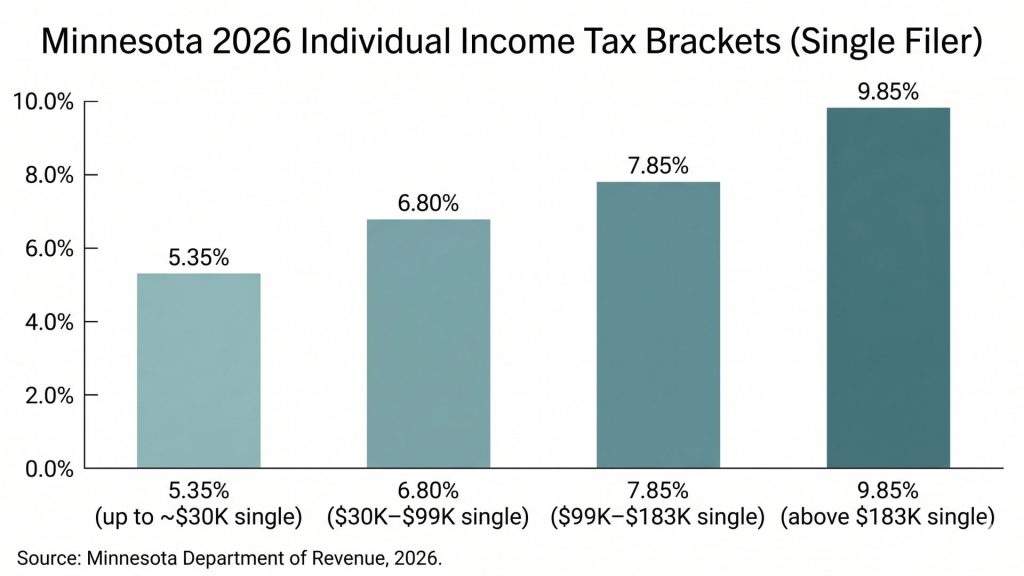
Minnesota’s income tax structure is one of the most common reasons people hesitate. The hesitation is understandable but often overstated.
Minnesota has four tax brackets ranging from 5.35% to 9.85%, according to the Minnesota Department of Revenue’s 2026 tax tables. The 9.85% top rate applies to single filers earning above roughly $183,000 and married filers above roughly $305,000.
Most working families in Minnesota pay an effective state rate of 6% to 8%, not 9.85%.
What the Tax Rate Actually Means
The Tax Foundation ranks Minnesota 44th overall on its 2026 State Tax Competitiveness Index, reflecting both the high income tax and relatively high corporate tax rate. But the same analysis acknowledges that Minnesota delivers meaningful public services in return.
What you get for the higher rate:
- Public school systems that consistently rank among the country’s strongest
- State parks infrastructure: 75 state parks, over 4,000 miles of trails, extensive lake access
- Roads and infrastructure maintained at high standards year-round, including snow removal at a level that makes Minnesota winters genuinely livable
- A state government that has historically been functional and solvent, a quality that’s rarer than it sounds
What still stings:
- Minnesota taxes Social Security income, though a 2023 law phases out that tax for most middle-income retirees
- The top rate kicks in at relatively moderate income levels compared to states like California or New York, where high rates apply to much higher earners
- There’s no way to soften the corporate tax rate: at 9.8%, it’s the second highest in the country, which creates real friction for business owners and the self-employed
The bottom line: if you’re a W-2 employee earning $60,000 to $150,000, the tax burden is real but manageable. If you’re a business owner, retiree with significant investment income, or high earner, get a tax projection before you move.
What Is the Housing Market Like in Minnesota?
The Twin Cities housing market in 2026 is noticeably more accessible than it was in 2021 and 2022, but it’s still a seller’s market in most desirable areas.The median sale price for the Twin Cities metro reached $390,000 in early 2026, up about 2% from the prior year, according to Minneapolis Area Realtors market data. Single-family detached homes ran higher, at a median of $429,000.
Inventory has improved from its pandemic-era lows but remains tight. The metro has roughly 2.0 months of supply for single-family homes, well below the 5 to 6 months that defines a balanced market.
What That Means for Relocating Buyers
Transplants face a specific challenge: you’re competing in a market you don’t know yet, with timelines set by your employer or lease, against buyers who’ve been watching specific neighborhoods for months.
Common mistakes transplants make:
- Picking a suburb based on commute alone, without considering school districts, community character, or what the area looks like in February
- Underestimating how fast good properties move in the $350K to $500K range, which averages 41 days on market but often gets multiple offers well before that
- Not accounting for the fact that inventory in the western Twin Cities corridor (Wayzata, Orono, Maple Grove, Plymouth) is structurally limited, and good lots for new construction are scarcer than resale listings suggest
Why Building Often Makes More Sense for Relocating Families
The families who’ve moved through our build process at TC Homes often tell us the same thing: they spent three months trying to find the right resale home and couldn’t. Either the neighborhood wasn’t right, the layout didn’t work, or the house needed more updating than the price suggested.
Building new gives relocating families something the resale market can’t easily provide: the ability to choose your neighborhood, your lot, and your layout at the same time, rather than accepting whichever two out of three the inventory happens to offer.
If you’re trying to figure out whether building or buying makes more financial sense for your situation, we’ve done a full breakdown. The answer depends on more than purchase price. Read: Building vs. Buying a Home →
What Does It Actually Cost to Live in Minnesota?
The MIT Living Wage Calculator sets the baseline for a single adult in Minnesota at roughly $22 per hour in 2026, and $23 per hour in the Minneapolis-St. Paul metro specifically. For a family with two adults and one child, that climbs to around $37 per hour statewide.
Those figures represent what you need to cover basic necessities without financial stress: housing, food, healthcare, transportation, and taxes. They’re not luxury figures. They’re not poverty figures either. They’re the zone where life is genuinely sustainable.
The Real Cost Drivers in Minnesota
Housing
The biggest variable. The Twin Cities offers a wide range, from entry-level condos in the high $100s to custom lakeshore homes well above $1M. The outer suburbs (Maple Grove, Plymouth, Eden Prairie, Shakopee) offer the best balance of school quality, space, and price for families in the $400K to $600K range.
If you want to understand how TC Homes runs a build from first conversation to keys in hand, the process page walks through every phase. See How Our Process Works →
Heating
This is real and often surprises transplants:
- A well-insulated home in Minnesota averages $150 to $250 per month in heating costs during winter.
- An older, poorly insulated home can run significantly higher.
- New construction with modern energy codes is dramatically more efficient, which matters across a 20-year ownership horizon, not only in the first heating season.
Transportation
Minnesota is primarily a car culture outside of core Minneapolis and Saint Paul. Budget for vehicle ownership and maintenance in most suburban communities. Winter tires are not legally required but are strongly recommended; all-season tires perform acceptably on maintained roads but noticeably worse in active snowfall.
Childcare
One of the genuine financial pressure points. Full-time daycare in the Twin Cities metro runs roughly $1,400 to $1,800 per month per child. Minnesota has expanded childcare support programs, but demand significantly outpaces available subsidized slots.
| Cost Category | Twin Cities Range (2026) | Notes |
|---|---|---|
| Median home purchase price | $390,000 – $429,000 | Single-family detached, Twin Cities metro |
| Average monthly rent (2BR) | $1,400 – $1,900 | Varies significantly by suburb and proximity to core |
| Monthly heating cost (new construction) | $120 – $180 | Older homes can run $250+ |
| Full-time daycare per child | $1,400 – $1,800/month | High demand; start search early |
| State income tax (effective rate, $80K income) | ~6.8% | Varies by deductions and filing status |
| Monthly car insurance (metro area) | $120 – $200 | Slightly above national average |
Ranges reflect general 2026 estimates and vary by location, provider, and household circumstances.
What Are the Best Areas to Live Near the Twin Cities?
The Twin Cities metro is large and varied. What works for a single tech worker in their 30s looks very different from what works for a family with three kids in school.
Western Suburbs (Wayzata, Orono, Plymouth, Maple Grove, Minnetrista)
This is TC Homes’ primary territory. The western corridor offers the state’s top-ranked school districts, access to Lake Minnetonka, lower crime rates, and a genuine mix of established neighborhoods and new construction opportunity.
Best for: Families prioritizing schools, lake access, and long-term home value. Higher cost of entry than the south or north metro.
South Metro (Eden Prairie, Chanhassen, Shakopee, Burnsville)
Strong schools, good highway access to Minneapolis, and a broad mix of housing types and price points. Eden Prairie in particular has become a significant employment hub in its own right.
Best for: Families who want suburban amenity without paying Wayzata prices.
North Metro (Maple Grove, Blaine, Andover, Champlin)
More affordable than the west and south, with good schools, newer housing stock, and relatively easy access to the northern suburbs employment base. A common choice for families where cost per square foot matters.
Best for: Families who want new construction at lower price points than the western suburbs.
Saint Paul and Inner Ring
More urban character, older housing stock, walkable neighborhoods, and a stronger food and arts scene than most suburbs offer. The east metro (Woodbury, Stillwater) has its own strong appeal for families who want a slower pace.
Best for: Buyers who want more character, walkability, and neighborhood density.
TC Homes builds across the western Twin Cities corridor. See the specific communities we serve. View Our Service Areas →
How Do You Actually Prepare for a Minnesota Winter?

Minnesota’s January average temperature in Minneapolis is 18°F, which makes it one of the 10 coldest major cities in the country. That’s the average. Polar vortex events push wind chills to -30°F or below several times a decade. The winters are not hypothetically cold; they’re operationally cold in ways that require specific preparation.
The good news: Minnesotans have spent 150 years engineering their environment for exactly this. Roads get plowed. Pipes don’t burst in well-maintained homes. Employers don’t close for snow days unless conditions are extreme. Life continues mostly normally through a Minnesota winter if you’re set up for it.
What You Actually Need
Clothing
- A genuine parka rated to -20°F or below, not a ski jacket
- Insulated, waterproof boots with good traction for ice
- Wool or synthetic base layers; cotton fails at low temperatures
- A face covering and goggles for days with extreme wind chill
Your Car
- All-season tires are the minimum; dedicated snow tires are noticeably better on ice
- A car emergency kit: jumper cables, a blanket, hand warmers, a small shovel
- Remote start is worth every penny of the installation cost
- Keep your gas tank above half through winter to prevent fuel line issues
Your Home
- Programmable or smart thermostats to manage heating costs without sacrificing comfort
- Weatherstripping on doors and windows; older homes benefit significantly
- A snow blower for driveways longer than about 30 feet; shoveling all winter is exhausting
- Know where your shutoff valves are in case of a frozen pipe emergency
Your Mindset
People who thrive in Minnesota winters find ways to use them rather than endure them. Cross-country skiing, ice fishing, snowshoeing, hockey, and winter farmers markets are all genuine winter activities with real followings. The people who struggle are those who go into winter planning to hibernate from November to April. That’s four to five months of life to waste.
What Do You Need to Do When You Move to Minnesota?
Once you’re in Minnesota, there are practical steps to handle within your first 60 days.
Driver’s License and Vehicle Registration
You must transfer your out-of-state driver’s license and register your vehicle with the Minnesota Department of Public Safety within 60 days of establishing residency. Minnesota does require a driving knowledge test for most out-of-state transfers; you can’t simply exchange your license at the counter.
Voter Registration
Minnesota allows same-day voter registration at the polls, but you can register in advance online or by mail. Proof of Minnesota residency is required.
Schools
If you have school-age children, contact your chosen school district as soon as you have an address confirmed. Popular districts like Wayzata, Orono, Eden Prairie, and Minnetonka receive significant transfer inquiries from new residents; understanding open enrollment policies early saves time.
Healthcare
Minnesota has a well-developed healthcare system, particularly in the Twin Cities metro. UnitedHealth Group, Fairview Health, Allina Health, and HealthPartners are the major networks. If you’re changing employers, plan healthcare coverage transitions carefully around Minnesota’s open enrollment periods.
What Should You Know About Building a New Home After Moving to Minnesota?
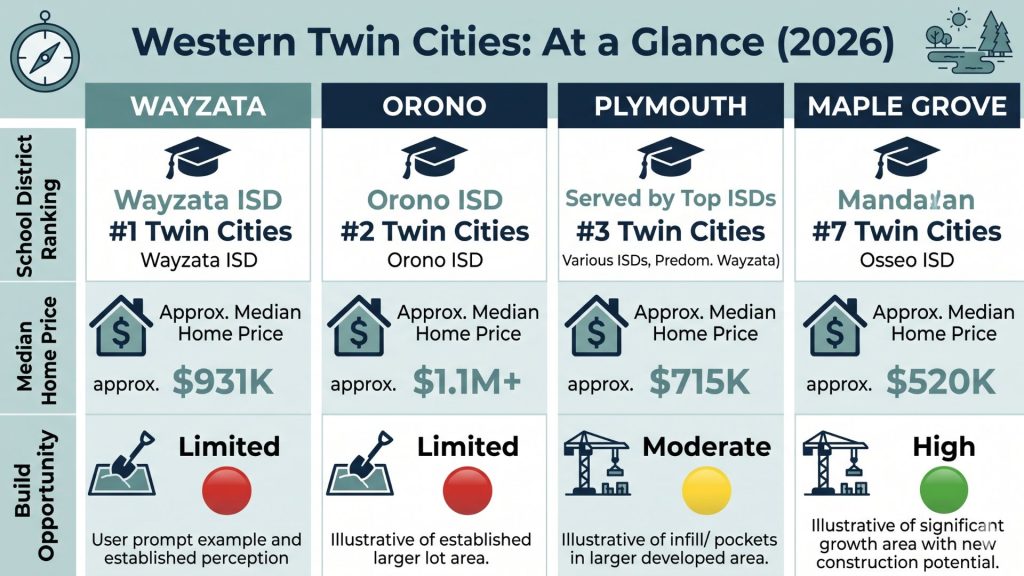
For transplants who want to plant permanent roots rather than buy an interim home, building new in the Twin Cities western suburbs is a serious option worth understanding.
The western corridor (Wayzata, Orono, Minnetrista, Plymouth, Maple Grove) has tight resale inventory and a strong tradition of custom and semi-custom building. Families who commit to a specific community and build there tend to stay put, which reflects both the quality of the communities and the fact that the home was designed for their life rather than someone else’s.
What’s different about building in Minnesota versus other states:
- Energy codes are among the most stringent in the country, which means new construction performs dramatically better through winter than older resale homes
- Seasonal planning matters: foundation and framing work runs most efficiently from spring through fall, though Minnesota builders work year-round
- Lot availability in desirable western suburbs is limited and often off-market; working with a builder who has existing relationships in those communities is the most efficient path to finding land
If you want to see what custom and semi-custom homes look like in the communities you’re considering, the gallery is the best starting point. View TC Homes Gallery →
What Does It Cost to Build a House in Minnesota?
Custom home construction in the Twin Cities metro typically runs $250 to $400 per square foot for the build, not counting land. Land in the western suburbs ranges from $280,000 for a standard Plymouth lot to $1M or more for Orono waterfront.
For a 2,800 to 3,500 square foot home in the western suburbs, a realistic all-in budget including land, site work, and construction runs from $900,000 to $1.6M depending on community, lot characteristics, and specification level.
Those numbers sound large. They are large. But the relevant comparison isn’t rent or a starter home; it’s the total 20-year cost of a custom home built to your life versus cycling through two or three resale homes that never quite fit.
We’ve written a detailed breakdown of what it costs to build in Minnesota, with actual per-square-foot ranges and what drives the variation. Read: Cost to Build a House in Minnesota →
How Long Does It Take to Build a Custom Home in Minnesota?
A custom home in the Twin Cities corridor typically takes 10 to 14 months from breaking ground to occupancy. Add 2 to 4 months for design, engineering, and permitting before construction starts.
Minnesota’s winters don’t stop construction, but they slow specific phases. Foundation work and framing are most efficient in warmer months. Builders who operate year-round plan their sequencing around the season rather than hoping it doesn’t matter.
For a full breakdown of what drives timeline and what you can do to speed it up, the build timeline article covers everything. Read: How Long Does It Take to Build a House? →
FAQ: Moving to Minnesota
Is Minnesota Expensive to Live In?
Relative to major coastal metros, Minnesota is meaningfully more affordable. The Twin Cities median home price of around $390,000 in early 2026 compares favorably to comparable metros like Denver, Austin, or Washington D.C. The higher state income tax is real but typically offset by lower housing, transportation, and general cost-of-living expenses for most households. The MIT Living Wage Calculator puts the baseline for a single adult in Minnesota at roughly $22 per hour in 2026, lower than most coastal states.
What Are Minnesota Winters Actually Like?
Long and legitimately cold, without apology. Minneapolis averages 18°F in January, with wind chills regularly hitting -20°F or below during polar vortex events. Snow typically begins in November and ice can persist into April. The winters are manageable with proper preparation but genuinely unpleasant if you move expecting mild cold. Most long-term Minnesota residents don’t just tolerate winter; they find ways to use it.
What Is the Minnesota “Nice” Phenomenon?
Minnesota Nice is real and can catch transplants off guard. Minnesotans are genuinely warm, helpful, and polite, but social circles here tend to be long-established, and people are slow to add new friends. Transplants consistently report that it takes one to two years to build the kind of social network that forms in weeks in more open-culture cities. This is worth knowing before you move, not after.
Is Minnesota a Good State for Families?
Consistently one of the best. The school districts in the western suburbs rank among the strongest in the country. The state’s park system is extensive and well-funded. Youth sports infrastructure, particularly hockey and baseball, is exceptional. Crime rates in the suburbs are low. For families who prioritize education, outdoor access, and community safety, Minnesota delivers reliably.
How Do I Find a Lot to Build On Near the Twin Cities?
Most of the best lots in the western suburbs never hit the open market. They move through builder relationships, estate sales, and off-market connections. Working with a local builder who actively sources land in your target communities is a more effective path than searching real estate listings. TC Homes regularly helps clients identify and evaluate lots in Wayzata, Orono, Plymouth, Maple Grove, Minnetrista, and Mound before those parcels appear publicly.
What Is the Difference Between Minneapolis and the Twin Cities?
Minneapolis is the largest city in Minnesota and one of two core cities, along with Saint Paul, that anchor the Twin Cities metro. When people say “Twin Cities” they typically mean the broader metro area of roughly 3.7 million people, which includes Minneapolis, Saint Paul, and dozens of suburbs extending 30 to 40 miles in every direction. Most TC Homes clients build in the western suburbs of the metro, outside the city limits of Minneapolis itself.
Minnesota Rewards People Who Move Here Intentionally
The people who struggle after moving to Minnesota usually share one thing: they underestimated either the winter or the social culture, and they weren’t prepared for either.
The people who thrive share something different. They chose a specific community, picked it deliberately and committed to it. They prepared their home and their wardrobe for what winter actually is. They got out in January instead of staying in. And most of them will tell you, unprompted, that they’re not going anywhere.
Brian Tutt and the TC Homes team have been building in the western Twin Cities corridor for over 32 years. We’ve watched hundreds of families arrive from other states and put down roots. The ones who build rather than settle for whatever the resale market offers almost always end up more satisfied long-term. Their home fits the life they planned for Minnesota, not the life someone else lived before them.
If you’re serious about relocating to the Twin Cities and want to understand whether building makes sense for your timeline and budget, the first conversation costs nothing and takes 30 minutes.
Ready to talk about building in the western Twin Cities? We can help you understand your options before you’re under any pressure to decide. Contact TC Homes →