What you need to know now about things to do in Minnetonka, MN:
- Minnetonka has more than 50 city parks and over 100 miles of trails, plus direct frontage on the eastern edge of Lake Minnetonka.
- The Minnetonka Farmers Market sets up every Tuesday afternoon from June through September at The Marsh.
- Ridgedale Center anchors a shopping and dining district with roughly 140 stores, a short drive from almost every neighborhood in the city.
- Three well-regarded school districts and a deep bench of parks are a big part of why families who visit end up staying.
Keep reading for the specific parks worth your Saturday, the market day locals build their week around, and why so many people end up putting down roots here.
What Is There to Do in Minnetonka, MN?
Minnetonka is a western Twin Cities suburb built around water, woods, and a surprising amount of corporate muscle for a city of its size.
It is home to Cargill and UnitedHealth Group, two of the largest companies in the country.
Most of a typical week here revolves around something a lot simpler: a trail, a lake view, a Tuesday market.
The city has quietly become one of the more livable spots in the west metro.
Part of that is geography. Part of it is that Minnetonka never tried to be flashy about any of it.
What Are the Best Parks and Trails in Minnetonka, MN?
Minnetonka’s park system is built around water and woods, with the city’s largest preserve alone covering more ground than most small-town park systems combined.
The standout is a preserve tucked into the southwest corner of the city, the largest of Minnetonka’s community parks. It has a wilder feel than most suburban parks.
Hardwood forest. Minimal elevation change. Enough distance between trailheads that you can walk for an hour without crossing your own path twice.
On the east side, a park wraps around its namesake lake with close to two miles of formal trail.
Runners like it because you get real mileage without a single traffic light.
Closer to the center of the city, a creekside preserve follows Minnehaha Creek through mature oak and maple.
It is a favorite for an easy family walk in October.
Roughly a fifth of Minnetonka’s total land area is water or wetland. That is not an accident.
The city maintains more than 268 acres of parkland across 50 parks and over 100 miles of trails, and it shows the moment you get off the main roads.
| Park | Size | Location | Known For |
|---|---|---|---|
| Purgatory Community Preserve | 155 acres | Southwest Minnetonka | Largest community park, minimal elevation change |
| Lone Lake Community Park | 146 acres | Southeast Minnetonka | Nearly 2 miles of formal trail, lake views |
| Big Willow Community Preserve | 95 acres | Central Minnetonka | Minnehaha Creek frontage, athletic fields |
| Meadow Park | 100+ acres | North Minnetonka | Mix of active fields and preserved natural space |
Loving the idea of a Saturday spent outdoors here? See how Minnetonka stacks up against the other family-friendly suburbs we build in across the west metro. Explore: Best Suburbs in Minneapolis →
Where and When Is the Minnetonka Farmers Market?

The Minnetonka Farmers Market runs every Tuesday afternoon from June through September. It is one of those small-town rituals that survives inside a big western suburb.
The market sets up at The Marsh parking lot, 15000 Minnetonka Boulevard.
It runs Tuesday afternoons from June through September, with the 2026 season stretching from June 2 through the end of September.
Expect two to six in the afternoon. Thirty-plus rotating vendors. The kind of produce selection that makes a Tuesday grocery run feel unnecessary.
Kids get their own reason to come along. A produce voucher program lets younger visitors pick out fruits and vegetables with their own few dollars each week.
That sounds small until you watch a six-year-old take that decision very seriously.
Bring cash if you can, though most vendors take cards now. Get there earlier rather than later. The good tomatoes do not last past four o’clock.
A Tuesday evening at the market is a pretty good argument for this town. Some families take that feeling one step further and end up building right on the water. Read: Lake Minnetonka Homes →
What Are the Best Restaurants Near Minnetonka?
Minnetonka’s dining scene is spread across a few pockets rather than concentrated on one strip. That takes some getting used to if you expect a single restaurant row.
The area around Ridgedale has the highest concentration, a mix of fast-casual spots and sit-down restaurants that pull diners in from across the west metro.
The Opus Business District has quietly built its own lunch crowd. Restaurants there lean toward the professionals working nearby, but they are just as good on a Saturday.
For something slower, a short drive toward the lake opens up patio seating with actual water views, especially in the warmer months.
We have clients who scout these spots as part of deciding whether they want lake access badly enough to build for it.
The honest answer on where to eat depends on whether you want convenience, a view, or something in between.
Minnetonka has all three within a fifteen-minute drive of nearly any address in the city.
Good food is easy to find here, and so are good building lots. We build custom homes throughout Minnetonka and the surrounding Lake Minnetonka communities. See: Our Service Areas →
Where Should You Go Shopping in Minnetonka?
Ridgedale Center is the retail anchor for the entire west metro, and it has held that position for decades.
The mall opened in the early 1970s and has expanded several times since.
Today it holds close to 140 stores under one roof, from major department store anchors to smaller specialty shops.
It is the kind of mall that pulls shoppers in from Wayzata, Plymouth, and Eden Prairie, not just from inside Minnetonka’s own borders.
Beyond Ridgedale, smaller retail nodes are scattered through the Opus Business District and along Minnetonka Boulevard, mostly local shops and services rather than national chains.
It is not a downtown in the traditional sense. It is more like several small commercial pockets that add up to genuine convenience.
For a family thinking about where to settle, that matters more than it sounds like it should.
Groceries, a hardware store, a mall, and a pharmacy all within ten minutes changes how a neighborhood feels day to day.
Between Ridgedale and the Opus district, this city does not lack for convenience. Take a look at the kind of homes we have built for families who chose to settle here. View: Our Custom Home Gallery →
Why Do So Many Families Choose to Put Down Roots in Minnetonka?
Schools come up in almost every conversation we have with clients building in Minnetonka, and for good reason.
Three separate public school districts serve different parts of the city. That is unusual for a suburb this size and gives families more flexibility than most people expect.
The city itself points to Hopkins, Minnetonka, and Wayzata as its three primary public school districts, each with its own high school and its own reputation.
| District | District Number | High School |
|---|---|---|
| Minnetonka Public Schools | 276 | Minnetonka High School |
| Hopkins Public Schools | 270 | Hopkins High School |
| Wayzata Public Schools | 284 | Wayzata High School |
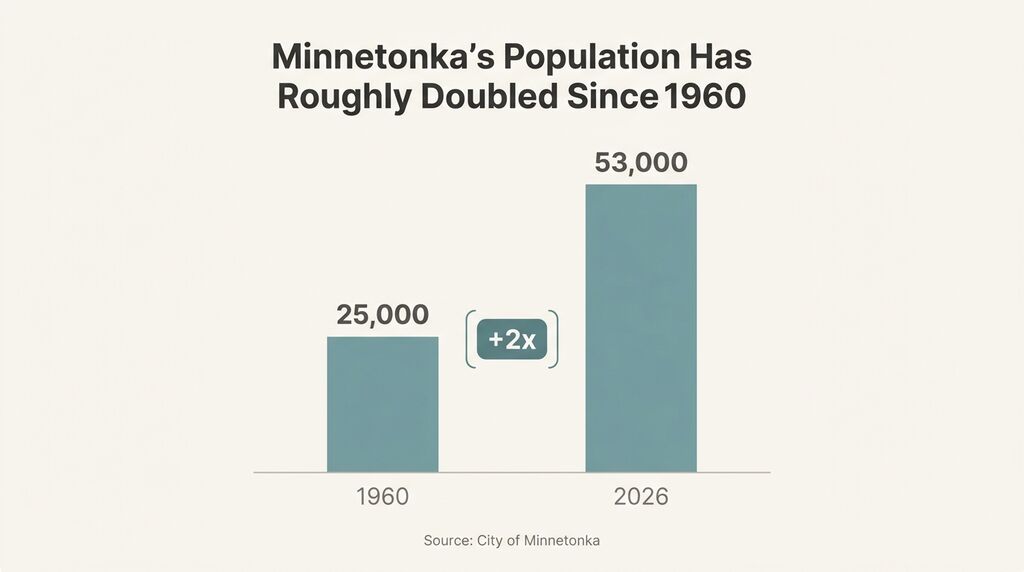
Beyond the schools, it comes down to something harder to put a number on. Minnetonka’s population has roughly doubled since 1960.
Nearly every family we talk to about building here mentions the same short list: good schools, real parks, an easy commute, and a lake nearby without lake-town prices on every lot.
None of that is an accident, and none of it happened overnight.
Strong schools and a quiet lot go a long way. If you are weighing whether to build new or buy something that already exists here, we broke down the real numbers. Read: Building vs. Buying a Home →
How Should You Start Getting Familiar with Minnetonka, MN?

The fastest way to actually get a feel for Minnetonka is to move through it in order, not at random. Start small with a trail, work up to the busier commercial areas, then spend time near the water. Each step builds on the one before it, and together they take less than a weekend.
Step 1: Walk One Trail Before Anything Else
Skip the highlights list and pick one trail near where you might actually live, not the busiest one in the city. Twenty minutes on foot tells you more about a neighborhood’s daily rhythm than any drive-through ever will.
Step 2: Show Up on a Tuesday
Time a visit so it lands on a Tuesday afternoon and swing by the farmers market, even if you do not need groceries. It is the fastest way to see who actually lives in Minnetonka day to day.
Step 3: Run an Errand at Ridgedale
Instead of touring the mall like a visitor, treat it like a resident would and pick up one real thing you need. Standing in a normal checkout line says more about daily pace here than a slow lap through the parking lot ever could.
Step 4: Drive the Streets Closest to the Lake
Once you have a feel for the busier commercial areas, spend twenty minutes driving the quieter streets near the water. Lot sizes and tree cover change fast within a few blocks of the shoreline, and no amount of online research replaces seeing it in person.
Step 5: Come Back in a Different Season
Whatever season you first visit in, come back in the opposite one before making any real decision. A Minnetonka summer and a Minnetonka winter test different things, and the version you fall for in July needs to hold up in February too.
Frequently Asked Questions About Things to Do in Minnetonka, MN
What Is Minnetonka Famous For?
Minnetonka is best known for being home to Cargill and UnitedHealth Group, two of the largest companies in the country, alongside its stretch of Lake Minnetonka shoreline and three highly regarded public school districts. Locals would probably add its park system to that list before anything else.
What Are Some Hidden Gems in Minnetonka?
Jidana Park is genuinely easy to miss, with no posted signage and a boardwalk that crosses a quiet marsh most visitors never find. Green Circle Park, tucked into the Opus Business District, wraps a paved loop around a small reservoir that most people driving past have no idea is there. History buffs should also look up the Charles H. Burwell House, an 1874 Victorian on the National Register of Historic Places that most people drive past without noticing.
Does Minnetonka Have a Traditional Downtown Area?
Not in the way Wayzata or Excelsior does. Minnetonka’s commercial activity is split between Ridgedale Center, the Opus Business District, and the historic Minnetonka Mills area, so there is no single Main Street to point to. Most residents consider that a feature, not a gap.
How Far Is Minnetonka From Minneapolis?
Minnetonka sits roughly 10 miles west of downtown Minneapolis, which usually works out to a 15 to 25 minute drive depending on traffic and which part of the city you are coming from. That makes it close enough for a daily commute without feeling like a Minneapolis suburb in name only.
Is Minnetonka a Good Place to Live?
For most of the families we work with, yes. The combination of strong school districts, an extensive park system, lake access, and established neighborhoods covers most of what people are actually looking for when they ask this question. The trade-off is that lots near the lake itself come at a premium, which is worth planning for early if that is part of the goal.
Minnetonka Is a Place Worth Building a Life In
We have built homes across Minnetonka for years, and the pattern is always the same.
People come for a visit, a market day, a walk through Purgatory Preserve. Somewhere in that first afternoon, they start picturing themselves staying.
That is not an accident. It is schools, parks, and a lake, all inside a fifteen-minute drive of nearly everything else you need.
If you are at the point where you are picturing your own address here, we would rather talk it through than have you guess at it alone.
You have seen what a week here looks like. Let’s talk about what building here looks like. Contact TC Homes →